Top Google Maps Ranking Factors Explained

Introduction
Google Maps has become one of the most powerful lead-generation platforms for local businesses.
Whether someone needs:
- A plumber
- Dentist
- Lawyer
- Restaurant
- HVAC contractor
- SEO agency
- Locksmith
their journey often begins with a Google Maps search.
When users search:
- “best dentist near me”
- “emergency plumber”
- “coffee shop open now”
Google displays local map results before many traditional organic listings.
That visibility directly impacts:
- Phone calls
- Direction requests
- Website visits
- Walk-in traffic
- Revenue
For many local businesses, ranking higher on Google Maps generates more leads than social media or paid advertising.
But Google Maps SEO is becoming increasingly competitive.
Businesses now need more than just a verified profile.
You need:
- Strong Google Business Profile optimization
- Reviews
- Local authority
- Website SEO
- Engagement signals
- Trust signals
- Entity optimization
This guide explains the top Google Maps ranking factors and how to improve Google Maps rankings using practical, modern local SEO strategies.
How Google Maps Rankings Work
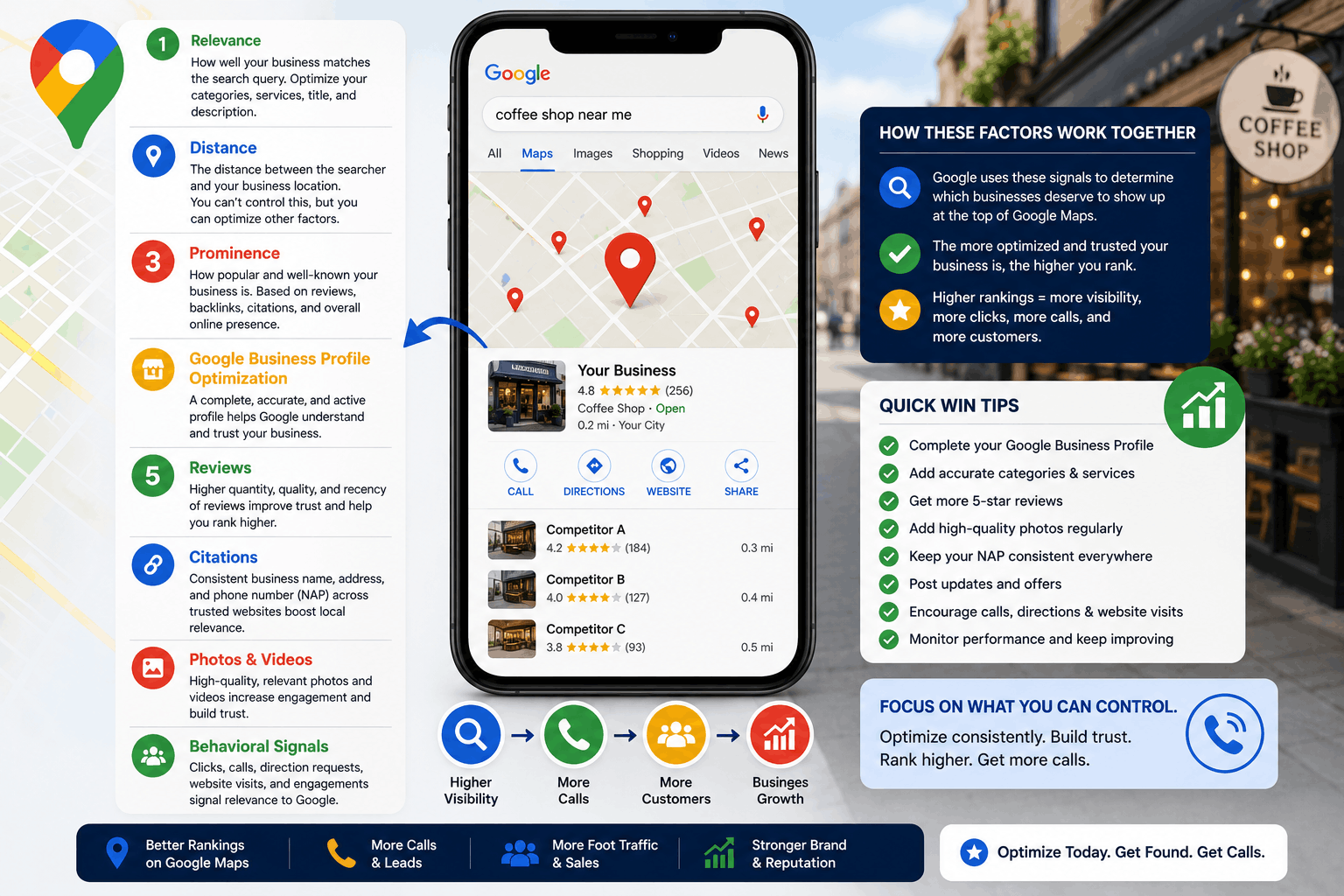
Google publicly states that local rankings are primarily based on:
- Relevance
- Distance
- Prominence
But modern Google Maps SEO involves many additional signals layered on top of these core principles.
Relevance
Relevance measures how closely your business matches a search query.
Google analyzes:
- Primary category
- Secondary categories
- Services
- Reviews
- Website content
- Business description
- Q&A content
- Products
- Local landing pages
Example
A business optimized for “emergency HVAC repair” is more likely to rank for emergency searches than a generic HVAC listing.
Distance
Distance refers to how close the business is to the searcher.
Google strongly personalizes local results based on user location.
This is why rankings fluctuate across neighborhoods and cities.
Important Insight
You cannot fully control proximity.
But you can improve visibility across larger service areas using:
- Hyperlocal pages
- Strong authority
- Better engagement
- Service-area optimization
Prominence
Prominence reflects how trusted and authoritative your business appears online.
Google evaluates:
- Reviews
- Links
- Citations
- Brand mentions
- Website authority
- Engagement
- Media coverage
- Local reputation
Strong prominence often allows businesses to outrank closer competitors.
Behavioral Signals
Google likely measures:
- Click-through rates
- Calls
- Direction requests
- Booking interactions
- Photo views
- User engagement
Listings generating stronger engagement often improve rankings over time.
Website Authority
Your website significantly influences local rankings.
Google evaluates:
- Local relevance
- Technical SEO
- Content quality
- Local backlinks
- Schema markup
- Mobile experience
Strong websites reinforce Google Maps trust signals.
Entity Signals
Google increasingly understands businesses as entities.
Strong entity signals include:
- Consistent branding
- Social profiles
- External mentions
- Structured data
- Authoritative citations
Entity SEO is becoming increasingly important in AI-driven search.
Trust Factors
Trust plays a massive role in local SEO.
Google evaluates:
- Review authenticity
- Listing accuracy
- Consistent business data
- Real-world legitimacy
- User interactions
Trustworthy businesses usually maintain stronger long-term rankings.
The Top Google Maps Ranking Factors Explained
1. Primary Google Business Profile Category
Your primary category is one of the strongest Google Business Profile ranking factors.
It tells Google exactly what your business is.
Why It Matters
A precise category improves relevance dramatically.
Example
Weak category:
- Consultant
Strong category:
- Personal Injury Attorney
Optimization Tips
- Use the most specific category possible
- Study top competitors
- Avoid broad generic categories
Common Mistake
Selecting inaccurate categories for extra visibility.
2. Secondary Categories
Secondary categories expand keyword relevance.
Example
A dental clinic may include:
- Cosmetic Dentist
- Pediatric Dentist
- Emergency Dental Service
Why It Matters
Google better understands your service scope.
Common Mistake
Adding irrelevant categories.
3. Business Name Optimization
Your business name should reflect real-world branding.
Why It Matters
Keywords in names still influence rankings.
But abuse creates suspension risks.
Best Practice
Use your legitimate business name consistently.
Common Mistake
Keyword stuffing:
“Best Cheap Plumber Dallas 24/7”
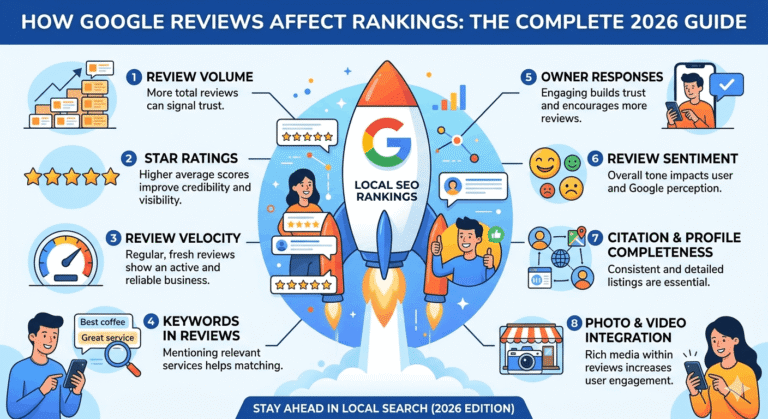
4. Google Reviews Quantity
Businesses with more reviews often rank better.
Why It Matters
Reviews are strong trust and prominence signals.
Optimization Tips
- Ask consistently
- Use SMS requests
- Simplify review links
Pro Tip
Review consistency matters more than sudden spikes.
5. Google Reviews Quality
Review quality matters more than raw volume.
Google evaluates:
- Detail
- Authenticity
- Sentiment
- User trust
Example
A detailed 5-star review is often more valuable than ten generic reviews.
6. Review Velocity & Freshness
Google prefers active businesses.
Why It Matters
Recent reviews signal ongoing customer activity.
Best Practice
Generate reviews steadily every month.
Common Mistake
Getting 100 reviews suddenly, then none for a year.
7. Review Keywords
Keywords inside reviews reinforce relevance.
Example
“Excellent emergency AC repair service.”
Why It Matters
Google understands contextual review language.
Pro Tip
Never force customers to use keywords unnaturally.
8. NAP Consistency
NAP = Name, Address, Phone Number.
Why It Matters
Consistency strengthens trust.
Important Areas
- GBP
- Website
- Directories
- Social profiles
Common Mistake
Different phone numbers across platforms.
9. Website Local SEO Signals
Your website strongly influences local pack rankings.
Important Signals
- Local keywords
- Service pages
- Location pages
- Schema markup
- Mobile optimization
Why It Matters
Google uses your website to validate local relevance.
10. Location Proximity
Distance remains a core ranking factor.
Reality Check
A nearby competitor often has a natural advantage.
Optimization Strategy
Build stronger authority and engagement to expand visibility.
11. Local Citations
Citations are mentions of your business online.
Examples
- Yelp
- Apple Maps
- Bing Places
- Industry directories
Why It Matters
Citations strengthen trust and legitimacy.
12. Backlinks & Local Authority
Backlinks remain extremely important.
Valuable Link Sources
- Local news
- Community organizations
- Industry blogs
- Sponsorships
Why It Matters
Links increase prominence.
13. Behavioral Signals
Google likely tracks:
- Calls
- Clicks
- Directions
- Booking actions
Why It Matters
High engagement signals user satisfaction.
14. Google Business Profile Completeness
Complete profiles perform better.
Important Elements
- Services
- Hours
- Photos
- Categories
- Descriptions
- Attributes
Common Mistake
Leaving profiles partially completed.
15. Photos & Media Activity
Fresh media improves engagement.
Why It Matters
Listings with active photo uploads usually generate more interactions.
Pro Tip
Upload real photos regularly.
16. Google Posts Activity
Google Posts help maintain listing freshness.
Effective Post Types
- Offers
- Events
- Tips
- Updates
Why It Matters
Fresh activity signals business legitimacy.
17. Q&A Engagement
The Q&A section is underrated.
Why It Matters
It improves relevance and conversions.
Best Practice
Seed important FAQs yourself.
18. Services & Products Optimization
Detailed service listings improve topical relevance.
Include
- Descriptions
- Pricing
- Service categories
Common Mistake
Using vague generic service names.
19. Local Landing Pages
Location-specific pages improve local visibility.
Example
Instead of:
“Plumbing Services”
Create:
- “Emergency Plumber in Brooklyn”
- “Drain Cleaning in Queens”
20. Mobile Optimization
Most local searches happen on mobile devices.
Why It Matters
Poor mobile experiences hurt conversions.
Key Areas
- Speed
- Click-to-call
- Navigation
- Readability
21. Domain Authority
Strong domains usually rank more consistently.
Signals Include
- Backlinks
- Content quality
- Brand trust
- Site authority
22. User Engagement Metrics
Google measures user satisfaction signals.
Examples
- Time on site
- Bounce rate
- Repeat searches
- Engagement actions
23. Brand Searches
Branded searches indicate popularity.
Example
Users searching specifically for your business name.
Why It Matters
Google interprets branded demand as authority.
24. Social Proof Signals
Social trust supports local SEO indirectly.
Examples
- Social mentions
- User-generated content
- Brand discussions
25. AI & Entity-Based Signals
Google increasingly relies on entity understanding.
Important Signals
- Consistent business identity
- External mentions
- Structured data
- Topical authority
Why It Matters
AI-powered search depends heavily on trusted entities.
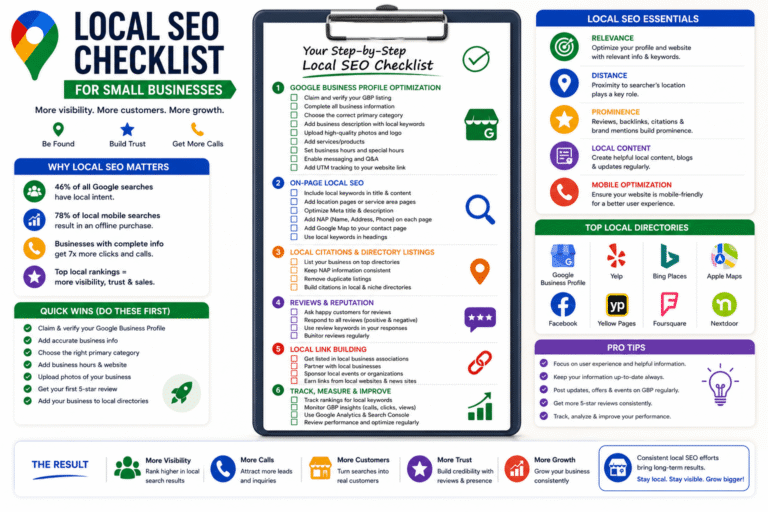
Google Business Profile Optimization Checklist
Categories
- Choose precise categories
- Add relevant secondary categories
Description
- Write naturally
- Include local relevance
- Explain services clearly
Services
- Add all core services
- Include descriptions
Images
- Upload weekly
- Use authentic business photos
Videos
- Add walkthroughs and demonstrations
Hours
- Keep accurate
- Update holidays
Messaging
- Enable and monitor regularly
Booking Links
- Reduce conversion friction
Attributes
- Add all relevant attributes
Products
- Showcase major offerings
FAQs
- Add common customer questions
Reviews
- Generate consistently
- Respond professionally
Posts
- Publish weekly updates
Advanced Google Maps SEO Strategies
Competitor Analysis
Study:
- Categories
- Reviews
- Photos
- Backlinks
- Posting activity
Top competitors reveal ranking patterns quickly.
Heat Map Ranking Tracking
Heat maps show ranking visibility across geographic areas.
Extremely valuable for:
- Agencies
- Multi-location brands
- Service-area businesses
Hyperlocal SEO
Target neighborhoods, districts, and suburbs.
Example
“HVAC Repair in Downtown Austin”
Hyperlocal pages often rank faster than broad city pages.
Service-Area Optimization
Optimize around realistic coverage areas.
Avoid setting massive irrelevant service zones.
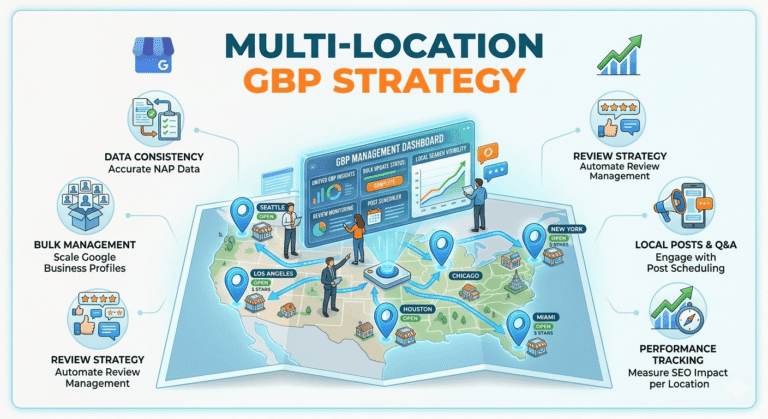
Multi-Location SEO
Each location should have:
- Unique profiles
- Unique pages
- Unique reviews
- Unique local content
Behavioral Optimization
Encourage:
- Calls
- Direction requests
- Website visits
- Engagement
Higher interaction signals often improve rankings.
AI Search Optimization
AI Overviews are changing local SEO rapidly.
Focus Areas
- FAQs
- Conversational content
- Entity SEO
- Structured data
Voice Search Optimization
Voice searches are highly conversational.
Example Queries
- “Who’s the best dentist near me?”
- “Which locksmith is open now?”
Entity SEO
Strengthen entity recognition through:
- Consistent branding
- External references
- Knowledge graph signals
Build Topical Authority
Deep content coverage improves local authority.
Create:
- Service guides
- FAQs
- Local resource pages
- Educational content
Common Google Maps Ranking Mistakes
Keyword Stuffing Business Names
Short-term gains often lead to long-term suspension risks.
Fake Reviews
Google is aggressively targeting review spam.
Duplicate Listings
Duplicates confuse Google and dilute authority.
Inconsistent Citations
Mismatched business information weakens trust.
Low-Quality Backlinks
Spam links can hurt local authority.
Ignoring Reviews
Inactive businesses lose engagement advantages.
Incomplete Profiles
Missing information reduces trust and visibility.
Spam Tactics
Aggressive manipulation often backfires.
How AI Is Changing Google Maps SEO
Google is rapidly evolving toward AI-driven local search experiences.
AI Overviews
AI-generated summaries increasingly appear in search results.
Google heavily relies on trusted business data sources.
Conversational Search
Users now search naturally:
- “Best pediatric dentist nearby with weekend appointments.”
Businesses optimized for conversational queries gain advantages.
Entity Recognition
Google increasingly ranks entities, not just webpages.
Strong business identity matters more than ever.
User Behavior Modeling
AI systems analyze:
- Engagement
- Satisfaction
- User interactions
- Trust signals
Future of Local SEO
The future belongs to businesses with:
- Strong entities
- Trusted brands
- Great customer experiences
- Accurate data
- Active engagement
Recommended Weekly Local SEO Workflow
| Task | Frequency |
| Upload photos | Weekly |
| Publish GBP posts | Weekly |
| Request reviews | Ongoing |
| Respond to reviews | Daily |
| Check citations | Monthly |
| Analyze competitors | Monthly |
| Monitor rankings | Weekly |
| Add FAQs | Monthly |
| Review GBP insights | Monthly |
Frequently Asked Questions
What are the top Google Maps ranking factors?
Primary category, reviews, proximity, website authority, engagement, and backlinks are among the strongest factors.
How do I rank higher on Google Maps?
Optimize your Google Business Profile, improve reviews, build local authority, and strengthen local SEO signals.
Do reviews affect Google Maps rankings?
Yes. Reviews strongly influence prominence, trust, and conversions.
How important is the primary category?
It is one of the most important Google Business Profile ranking factors.
Does website SEO affect Google Maps rankings?
Absolutely. Strong local SEO supports better map visibility.
What are behavioral signals in local SEO?
Signals like calls, clicks, direction requests, and user engagement.
How important are local backlinks?
Very important. They increase authority and prominence.
Does posting on GBP help rankings?
Posts improve freshness and engagement signals.
What causes Google Maps ranking drops?
Suspensions, citation inconsistencies, review issues, weak engagement, and competitor improvements.
How often should I update my GBP?
Weekly activity is recommended.
Are citations still important?
Yes. Consistent citations remain foundational trust signals.
How does AI impact local SEO?
AI increasingly relies on entities, trust signals, and structured business data.
Can fake reviews hurt rankings?
Yes. They can trigger penalties and trust issues.
What is local pack ranking?
Ranking inside Google’s top local map results.
How long does local SEO take?
Most businesses see meaningful improvements within 3–6 months.