GBP SEO Checklist for 2026: The Complete Guide to Google Business Profile Optimization

Your Google Business Profile (GBP) is the single most powerful local SEO asset you own — and it is completely free. In 2026, with Google AI Overviews dominating the top of search results and local intent queries growing by over 20% year-on-year, a fully optimized GBP is no longer optional. It is the difference between appearing in the coveted Google Maps 3-Pack or being invisible to nearby customers.
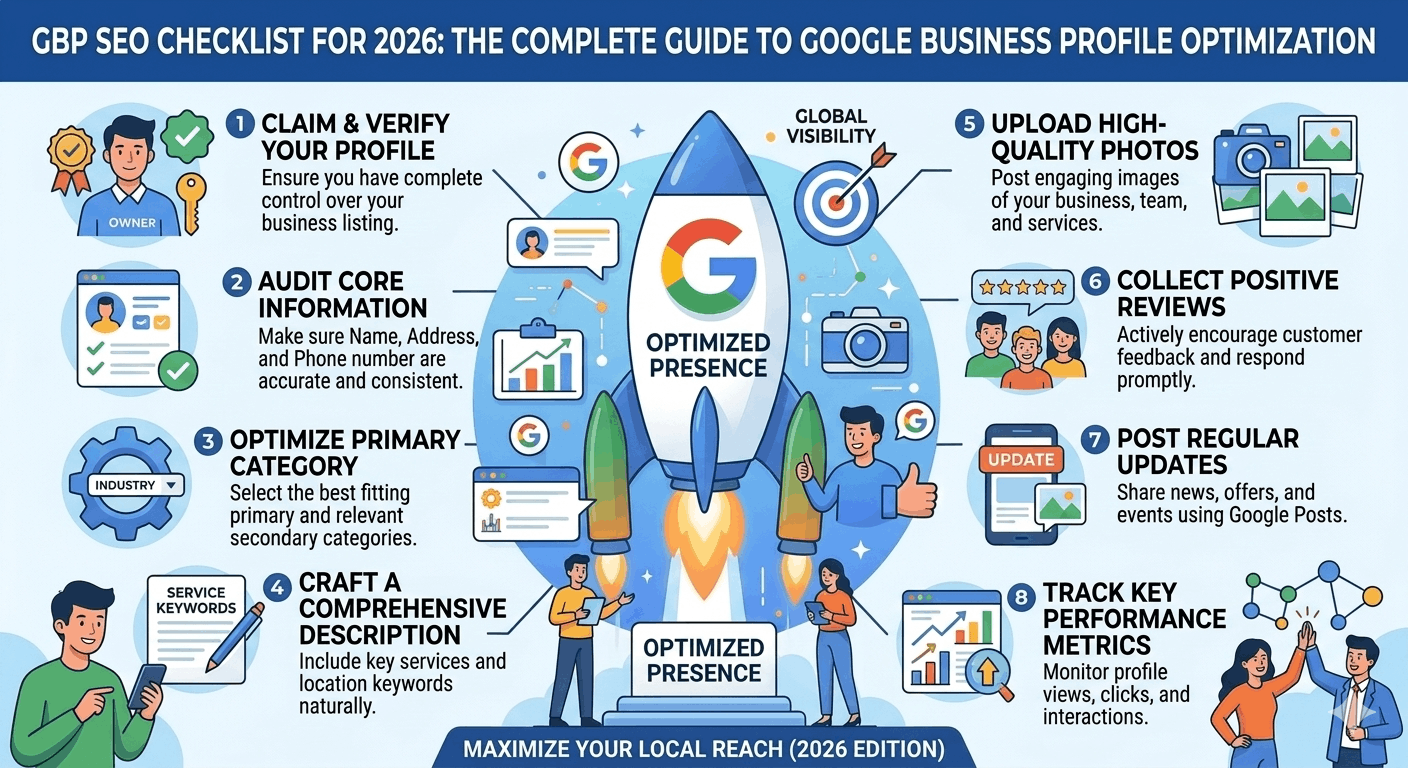
This GBP SEO checklist gives you a step-by-step framework — covering every ranking factor, optimization lever, and ongoing maintenance task — so you can improve your Google Maps ranking, attract more local customers, and outperform competitors.
Whether you are a local business owner, a marketing manager, an SEO agency, or a franchise operator, this guide covers everything you need to know.
💡 Internal link opportunity: Link ‘Google Business Profile’ to your ‘What is Google Business Profile?’ explainer post.
Quick Answer: What Is a GBP SEO Checklist?
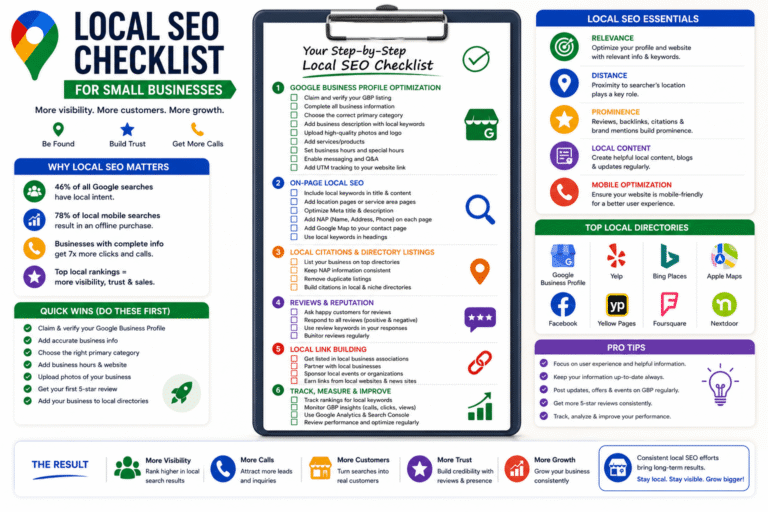
A Google Business Profile SEO checklist is a structured list of optimization actions designed to improve how your business ranks in Google Maps and local search results. It covers profile completeness, review acquisition, photo quality, Google Posts, Q&A, website integration, and AI search optimization.
The most important GBP ranking factors are:
- Relevance — Does your category and description match the search query?
- Distance — How close is your business to the searcher?
- Prominence — How well-known and trusted is your business online?
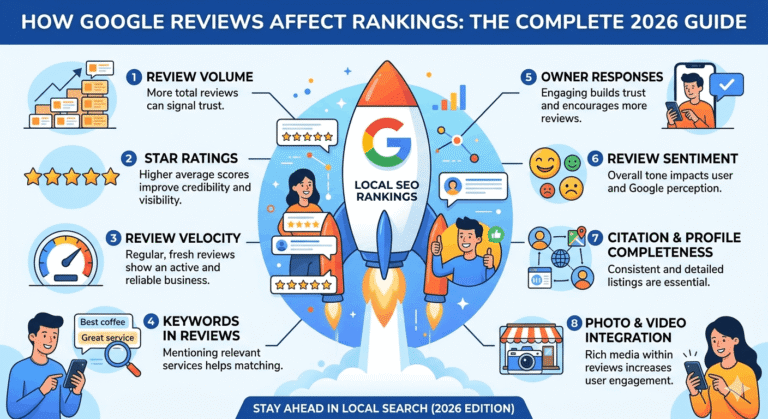
- Reviews — Quantity, quality, recency and keyword-rich responses.
- Engagement — Clicks, calls, direction requests and photo views.
Use the quick-reference table below to see all checklist areas at a glance:
| Checklist Area | Key Action | Priority |
| Profile Setup & Verification | Claim, verify, correct business name & category | 🔴 Critical |
| Business Information | Complete description, services, hours & attributes | 🔴 Critical |
| Location & Service Area | Define service areas, add local landing pages | 🟠 High |
| Review Management | Acquire, respond & use keywords in replies | 🔴 Critical |
| Photo & Video | Logo, cover, team, product & geotagged images | 🟠 High |
| Google Posts | Weekly posts with offers, events & strong CTAs | 🟡 Medium |
| Q&A Optimization | Seed FAQs, monitor & answer with local keywords | 🟡 Medium |
| Website Integration | Schema markup, local landing pages & UTM links | 🟠 High |
| AI & AEO Optimization | Entity SEO, structured data & citation consistency | 🟠 High |
GBP SEO Checklist for 2026
✅ Profile Setup & Verification
- ☑ Claim ownership of your Google Business Profile at business.google.com
- ☑ Complete phone or postcard verification — unverified profiles cannot rank
- ☑ Use your exact legal business name — no keyword stuffing (a direct violation of GBP guidelines)
- ☑ Select the most accurate primary category — this is the #1 relevance signal
- ☑ Add up to 9 secondary categories to broaden your visibility
- ☑ Ensure NAP (Name, Address, Phone) is 100% consistent across GBP, website and all citations
✅ Business Information Optimization
- ☑ Write a keyword-rich business description (750 characters max) — lead with what you do and where
- ☑ Add all services with detailed descriptions and pricing where possible
- ☑ Add products with images, prices and descriptions
- ☑ Complete all applicable attributes (Wi-Fi, parking, accessibility, payment methods, etc.)
- ☑ Set accurate opening hours including lunch breaks
- ☑ Add holiday hours for every public holiday to avoid ‘Hours may differ’ warnings
- ☑ Add appointment or booking links to reduce friction
💡 Tip: Attributes like ‘Women-led’, ‘LGBTQ+ friendly’ and ‘Veteran-owned’ attract specific searcher segments and improve relevance signals.
✅ Location & Service Area Optimization
- ☑ For service-area businesses (SABs): hide your address and define all service areas by suburb or postcode
- ☑ Add up to 20 service areas — be precise, not greedy
- ☑ For brick-and-mortar: ensure your pin is dropped at the correct location on Google Maps
- ☑ Create dedicated local landing pages on your website for each major service area
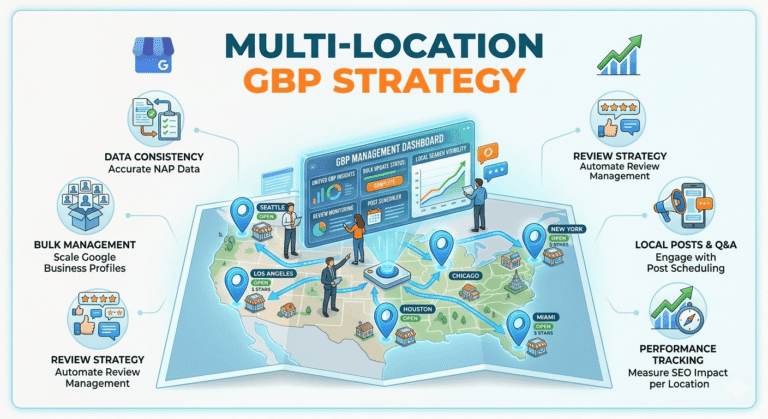
- ☑ Multi-location businesses: create a separate, individually verified GBP for each location
💡 Internal link opportunity: Link ‘local landing pages’ to your guide on creating location pages for SEO.
✅ Review Management
- ☑ Build a systematic review request process — email, SMS or QR code post-service
- ☑ Respond to every single review, positive and negative, within 48 hours
- ☑ Naturally weave your primary service keywords and location into positive review responses
- ☑ For negative reviews: acknowledge, apologize, take it offline — never argue publicly
- ☑ Report and flag fake or spam reviews to Google via the GBP dashboard
- ☑ Aim for a steady cadence of new reviews — recency matters as much as quantity
✅ Photo & Video Optimization
- ☑ Upload a high-resolution logo (250×250px minimum)
- ☑ Upload a compelling cover photo that represents your brand (1024×575px)
- ☑ Add team and staff photos to build trust
- ☑ Upload before-and-after images for service businesses
- ☑ Geotag your images with your business coordinates before uploading — use a free tool like GeoImgr
- ☑ Upload short videos (30 seconds, under 100MB) — GBP prioritizes video in photo carousels
- ☑ Aim for 10+ photos; businesses with 100+ photos get 1,065% more website clicks (Google data)
✅ Google Posts Strategy
- ☑ Publish 1–2 posts per week minimum to signal an active profile
- ☑ Use ‘Offer’ posts for promotions with a start/end date — they show a special badge in Maps
- ☑ Use ‘Event’ posts for webinars, open days or seasonal campaigns
- ☑ Use ‘Update’ posts for news, tips or service highlights
- ☑ Include a strong CTA in every post: ‘Book Now’, ‘Get a Free Quote’, ‘Learn More’
- ☑ Use local keywords and services naturally within post copy
💡 Image tip: Posts with images receive 3× more engagement — use your branded template for consistency.
✅ Q&A Optimization
- ☑ Seed the Q&A section with your 5–10 most common customer questions and answer them yourself
- ☑ Use your primary service keywords and location in answers
- ☑ Monitor user-generated questions — Google will show these without your input if left unanswered
- ☑ Upvote your own seeded Q&As to help them surface higher
- ☑ Enable Google Alerts for your business name to catch new Q&As quickly
✅ Messaging & Engagement
- ☑ Enable Messaging in your GBP dashboard to allow customers to contact you directly via Search
- ☑ Set a target response time of under 24 hours — Google can deactivate messaging if response time is poor
- ☑ Set up Welcome Messages so customers get an instant acknowledgment
- ☑ Consider call tracking numbers via CallRail or similar — UTM parameters track GBP calls in GA4
✅ Website & Local SEO Integration
- ☑ Link GBP to your main location page or a dedicated local landing page (not the homepage for multi-location businesses)
- ☑ Add LocalBusiness schema markup to your website with NAP, hours, services and review data
- ☑ Add UTM parameters to your GBP website link: ?utm_source=google&utm_medium=organic&utm_campaign=gbp
- ☑ Ensure internal linking flows to and from your location/service pages
- ☑ Build locally-relevant backlinks from chambers of commerce, local directories and industry bodies
💡 Schema types to implement: LocalBusiness (or subtype), FAQPage, Service, Review, BreadcrumbList.
✅ AI Search & AEO Optimization
Google AI Overviews and conversational AI tools (ChatGPT, Perplexity, Google SGE) now surface local business information. To be included:
- ☑ Write FAQ content that directly answers conversational queries (‘Who is the best plumber near me?’)
- ☑ Optimize for entity completeness — every data point Google knows about you should match across GBP, website and citations
- ☑ Use FAQ schema and HowTo schema on your website pages
- ☑ Maintain consistent citations across the top 50 local directories (Google, Yelp, Apple Maps, Bing, TrueLocal, Yellow Pages, etc.)
- ☑ Build topical authority on your website — in-depth service pages rank better and feed AI knowledge graphs
Top GBP Ranking Factors in 2026
Google’s local ranking algorithm evaluates three core pillars: relevance, distance, and prominence. In 2026, behavioral and engagement signals are increasingly weighted alongside these fundamentals.
| Ranking Factor | What Google Looks At | Impact |
| Relevance | Category match, keywords in description, services listed | ★★★★★ |
| Distance | Proximity of searcher to your business location | ★★★★★ |
| Prominence | Reviews, backlinks, citations, website authority | ★★★★☆ |
| Reviews (Quantity) | Total number of reviews on GBP | ★★★★☆ |
| Reviews (Quality) | Average star rating, recency, keyword-rich replies | ★★★★☆ |
| Website Authority | DA, backlinks, page speed, Core Web Vitals | ★★★☆☆ |
| Engagement Signals | Clicks, calls, direction requests, photo views | ★★★☆☆ |
| Behavioral Signals | Dwell time, booking actions, repeat visits | ★★★☆☆ |
💡 Key insight: You cannot control distance — but you can dominate relevance and prominence through this checklist.
Common GBP SEO Mistakes to Avoid
- Keyword stuffing in your business name (e.g., ‘Joe’s Plumbing Sydney Emergency 24/7’) — this violates GBP guidelines and can lead to suspension.
- Using a virtual office or co-working address without a genuine, staffed presence — Google verifies physical locations.
- Ignoring duplicate GBP listings — multiple unmanaged listings split your authority and confuse customers.
- Inconsistent NAP information — even minor differences (St vs Street) across citations dilute trust signals.
- Neglecting reviews — letting weeks pass without requesting or responding to reviews signals inactivity to Google.
- Choosing a broad or incorrect primary category — choosing ‘Business’ instead of ‘Electrician’ destroys your relevance score.
- Leaving Q&A unanswered — user-submitted answers can include inaccurate information about your business.
- Never posting updates — inactive profiles lose rankings to consistently active competitors.
GBP SEO Checklist by Business Type
Every business type has different GBP priorities. Use the table below to focus on what matters most for your industry:
| Business Type | Top GBP Priority |
| Service-Area Business | Define all service areas; do NOT show address; create suburb landing pages |
| Restaurant | Enable booking link, upload food photos weekly, use offer posts for specials |
| Healthcare Provider | Add health services, set correct hours, enable appointment booking |
| Real Estate Agency | List agents as practitioners, create suburb pages, respond to every Q&A |
| Multi-Location Business | Separate verified profiles per location, consistent NAP, bulk verification |
| Retail Store | Add product catalogue, upload in-store photos, run seasonal offer posts |
Monthly GBP Maintenance Checklist
GBP optimization is not a one-time task. The profiles that rank consistently are those maintained consistently. Use this recurring task list:
| Frequency | Task | Tool |
| Weekly | Publish 1–2 Google Posts (offer, update or event) | GBP Manager |
| Weekly | Upload 2–3 new photos or a short video | GBP Manager |
| Weekly | Respond to all new reviews within 48 hours | GBP Manager / BrightLocal |
| Monthly | Audit NAP consistency across top 50 citations | BrightLocal / Whitespark |
| Monthly | Check Q&A — answer unanswered user questions | GBP Manager |
| Monthly | Review Local Falcon heatmap for rank changes | Local Falcon |
| Monthly | Analyse GBP Insights: calls, clicks & direction trends | GBP Manager / GA4 |
| Monthly | Competitor GBP audit (categories, posts, reviews) | Manual / Semrush Local |
| Quarterly | Full GBP audit against this checklist | Manual |
| Quarterly | Update business description & services list | GBP Manager |
💡 Print this table and pin it to your team dashboard or schedule recurring tasks in your project management tool.
Recommended Tools for GBP SEO
You don’t need every tool on this list — but combining a free tier with one paid platform covers 90% of your GBP management needs:
| Tool | Primary Use Case | Cost |
| GBP Manager | Manage profile, posts, reviews, Q&A directly | Free |
| Google Search Console | Track local keyword impressions & clicks | Free |
| Google Analytics 4 | Measure GBP-sourced website traffic & conversions | Free |
| BrightLocal | Citation audits, rank tracking, review management | From $39/mo |
| Whitespark | Citation building, local rank tracker, reputation | From $33/mo |
| Local Falcon | Geo-grid rank tracker (Maps heatmap view) | From $24/mo |
| Semrush Local | Listing management, review monitoring, Local SEO audit | From $50/mo |
💡 For agencies managing multiple clients: BrightLocal or Semrush Local offer multi-client dashboards with white-label reporting.
Measuring GBP Success: The KPIs That Matter
Track these metrics monthly using GBP Insights, Google Analytics 4 (with UTM tracking) and Google Search Console:
| KPI | Where to Find It | Target (Monthly Growth) |
| Phone Calls | GBP Insights > Calls | +5–10% MoM |
| Direction Requests | GBP Insights > Direction requests | +5% MoM |
| Website Clicks | GBP Insights / GA4 via UTM | +10% MoM |
| Keyword Rankings | GSC > Search results (local queries) | Top 3 in Maps |
| Review Growth | GBP Reviews tab | +4–8 reviews/month |
| Photo Views | GBP Insights > Photos | +15% MoM |
| Conversion Rate | GA4 > Goals from GBP source | >3% of clicks |
💡 Set up GA4 custom reports filtered by utm_source=google & utm_medium=organic & utm_campaign=gbp for clean GBP attribution.
Frequently Asked Questions About GBP SEO
Schema opportunity: Implement FAQPage schema for all questions and answers below.
1. How long does it take for GBP optimization to show results?
Most businesses see measurable improvements in impressions within 4–8 weeks of a full profile optimization. Review-driven ranking improvements typically take 3–6 months to compound.
2. Does adding photos to GBP help with ranking?
Yes. Google confirmed that photos improve engagement signals, which are a ranking factor. Profiles with 100+ photos receive significantly more website clicks and direction requests.
3. How many reviews do I need to rank in the Google Maps 3-Pack?
There is no magic number — it depends on your competitors. In most markets, 20–50 reviews with a rating above 4.3 stars is enough to be competitive. Recency and response rate matter as much as volume.
4. Can I rank in a city where I am not located?
For service-area businesses, yes — by defining service areas across nearby suburbs. For brick-and-mortar businesses, it is very difficult to rank in locations far from your physical address without dedicated local landing pages and strong citations.
5. Does my website affect my GBP ranking?
Yes. Your linked website’s authority, speed, relevance and schema markup all influence your GBP prominence score. A slow, thin website will hold back your Maps ranking.
6. How often should I post on Google Business Profile?
Aim for 1–2 posts per week. Consistency matters more than frequency. Businesses that post weekly are perceived as more active and relevant by Google’s algorithm.
7. What is the best primary category for my business?
Choose the category that most specifically describes your core offering. Use Google’s own category list and check what your top-ranking local competitors have selected as their primary category.
8. Can keyword stuffing in GBP get me penalized?
Yes. Adding keywords to your business name that are not part of your registered trading name violates Google’s guidelines and can result in profile suspension or ranking suppression.
9. How do I handle fake negative reviews on GBP?
Flag the review in your GBP dashboard using the ‘Report a problem’ option. Provide evidence via Google’s support chat if needed. While waiting for removal, respond professionally to demonstrate your commitment to customer service.
10. Is GBP important for AI search (ChatGPT, Google SGE)?
Yes. AI search engines pull local business data from GBP, your website entity information and structured data. A fully optimized GBP combined with FAQ and HowTo schema on your website significantly increases your chances of appearing in AI-generated local answers.
Conclusion: Start Optimizing Your GBP Today
Your Google Business Profile is the lowest-cost, highest-impact local SEO asset available to any business. In 2026, as AI search reshapes how customers find local services, a fully optimized GBP is your best defence against being overlooked.
Here are the key takeaways from this checklist:
- Complete every section of your profile — incomplete profiles cannot compete.
- Reviews are the single most controllable ranking lever — build a process to get them consistently.
- Post weekly, respond to everything, and keep your information up to date.
- Integrate your GBP with your website using schema, UTM links and local landing pages.
- Treat your GBP like a product — schedule monthly audits and quarterly reviews.
GBP optimization is never finished. Your competitors are constantly adding reviews, posting updates and refining their profiles. The businesses that win in local search are the ones that treat their GBP as an ongoing marketing channel, not a one-time setup task.