Local SEO vs Traditional SEO: What’s the Difference and Which Do You Need?
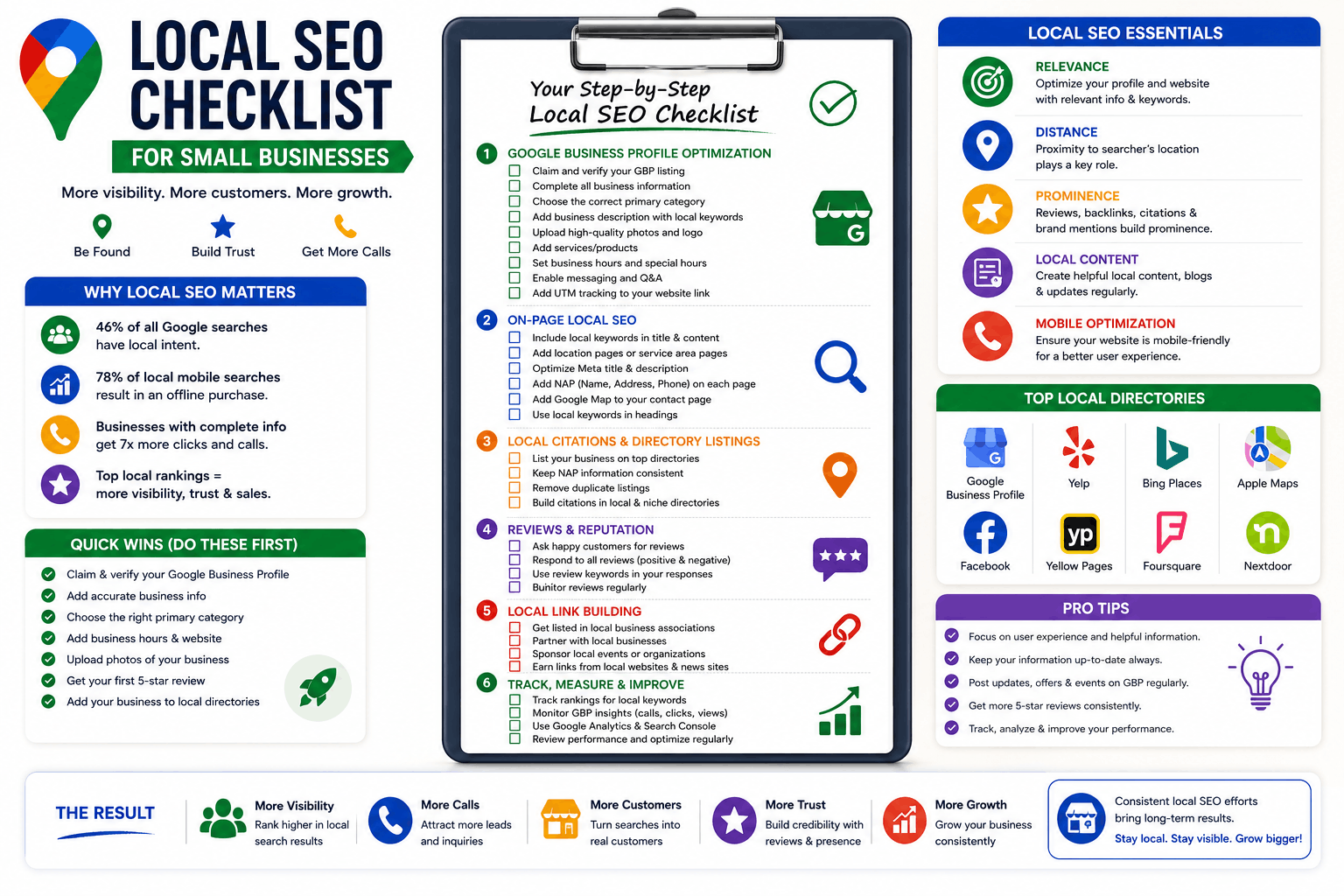

Most business owners talk about ‘SEO’ as if it is one thing — but there are actually two very different strategies hiding under that umbrella. Local SEO helps you get found by customers near your business. Traditional SEO (also called organic SEO) helps you rank for topics and keywords regardless of geography. Using the wrong strategy for your business model means spending time and money targeting people who will never become your customers.
A plumber in Perth does not need to rank #1 in New York. A SaaS company does not need to rank in Google Maps. Yet both of these mistakes happen constantly.
In this guide you will learn exactly what separates local SEO from traditional SEO, which ranking factors each one uses, and a clear decision framework to help you invest your SEO budget in the right place.
💡 Internal link opportunity: Link ‘Google Business Profile’ to your ‘What is GBP?’ guide and ‘organic search rankings’ to your ‘Beginner’s Guide to SEO’.
Quick Answer: Local SEO vs Traditional SEO
Local SEO optimizes your business to appear in geographically relevant searches — especially Google Maps and the local 3-Pack. Traditional SEO optimizes your website to rank in organic search results for topics that can be searched from anywhere. The core difference is intent and geography: local SEO targets ‘near me’ buyers; traditional SEO targets anyone searching online.
| Local SEO | Traditional (Organic) SEO | |
| Goal | Rank in Google Maps + local 3-Pack | Rank in organic search results nationally/globally |
| Audience | People searching near a specific location | Anyone searching online, regardless of location |
| Key asset | Google Business Profile | Website content and backlinks |
| Search examples | ‘dentist near me’, ‘plumber in Dallas’ | ‘how to fix a leak’, ‘best CRM software’ |
| Primary KPI | Calls, direction requests, Maps visibility | Organic traffic, keyword rankings, leads |
What Is Local SEO?
Local SEO is the process of optimizing your online presence so your business appears prominently when people search for products or services in your geographic area. The most important outcome is ranking in the Google Maps 3-Pack — the three business listings that appear in a box at the top of location-based search results.
Goal:
Drive local, high-intent customers to call, visit, or book — usually someone with an immediate need who is close to your location.
Key assets:
- Google Business Profile (GBP) — the most important local SEO asset
- Dedicated location landing pages on your website
- Customer reviews across Google, Apple Maps, Yelp and industry directories
- Local citations (consistent NAP listings across the web)
Typical local search queries:
🔍 ‘dentist near me’ — ‘plumber in Dallas’ — ‘coffee shop open now’ — ‘best Thai restaurant Surry Hills’ — ’emergency electrician Sydney’
These searches have strong purchase intent and near-zero tolerance for irrelevant results. The searcher is ready to act — your job is simply to appear and be trusted.
💡 Internal link opportunity: Link ‘Google Business Profile’ to your GBP optimization checklist article.
What Is Traditional SEO?
Traditional SEO — also called organic SEO or national SEO — is the process of optimizing your website’s content, authority and technical foundation so it ranks on Google’s organic search results pages for queries that are not location-dependent.
Goal:
Drive qualified website traffic from anyone searching for topics related to your product, service, or expertise — regardless of where they are located in the world.
Key assets:
- High-quality, search-intent-aligned blog and service content
- Authoritative backlinks from relevant, trusted websites
- Technical SEO foundations (speed, crawlability, Core Web Vitals)
- Topical authority — a comprehensive cluster of content around your niche
Typical traditional SEO queries:
🔍 ‘how to fix a leaking faucet’ — ‘best CRM software’ — ’email marketing strategies’ — ‘what is content marketing’ — ‘compare Shopify vs WooCommerce’
These searches often begin higher up in the funnel — someone researching, comparing, or learning before they buy. Traditional SEO builds awareness and trust over time, converting visitors through content rather than proximity.
Local SEO vs Traditional SEO: Key Differences
Here is a side-by-side breakdown of every major dimension that separates these two strategies:
| Factor | Local SEO | Traditional SEO |
| Search intent | ‘Near me’, transactional, ready-to-buy | Informational, navigational, or transactional |
| Geographic focus | Suburb, city or defined service area | National, regional or global |
| Target audience | Nearby customers with immediate need | Broad audience at any stage of the funnel |
| Primary ranking signal | GBP, reviews, NAP, proximity | Content quality, backlinks, authority |
| Content strategy | Local landing pages, GBP posts, location FAQs | Long-form blogs, pillar pages, topical clusters |
| Link building | Local citations, local directory links, community links | High-authority editorial backlinks, PR |
| Conversion goal | Phone call, visit, booking, direction | Lead form, email sign-up, purchase, content engagement |
| Competition | Local competitors in your city or suburb | National or global competitors in your niche |
| Key KPIs | Calls, direction requests, Maps rank, review count | Organic sessions, keyword positions, leads, revenue |
| Timeline to results | 4–12 weeks (with GBP + citations) | 3–12 months (content + link building compound) |
💡 Key insight: Traditional SEO results compound over 6–18 months as domain authority builds. Local SEO can show measurable results within 4–12 weeks, especially through GBP and review optimization — making it the faster-ROI strategy for service businesses.
Local SEO Ranking Factors
Google’s local ranking algorithm evaluates three core pillars: relevance (does your business match the query?), distance (how close are you to the searcher?), and prominence (how trusted and well-known is your business?). Here are the specific signals that feed those pillars:
| Local SEO Factor | What It Means | Impact |
| GBP Optimization | Complete, accurate, active Google Business Profile | 🔴 Critical |
| Reviews | Quantity, recency, star rating, keyword-rich responses | 🔴 Critical |
| NAP Consistency | Identical Name, Address, Phone across all citations | 🟠 High |
| Proximity | Distance between searcher and business location | 🟠 High (uncontrollable) |
| Local Citations | Listings in Google, Apple Maps, Yelp, Yellow Pages, etc. | 🟠 High |
| Local Backlinks | Links from locally relevant websites and directories | 🟡 Moderate |
| Behavioral Signals | Clicks, calls, direction requests, dwell time | 🟡 Moderate |
| Local Landing Pages | Unique location pages with schema and local content | 🟡 Moderate |
✅ The single fastest-impact local SEO action is fully completing your Google Business Profile, selecting the right primary category, and building a consistent review acquisition process.
Traditional SEO Ranking Factors
Google’s organic ranking algorithm weighs hundreds of signals, but the most impactful for traditional SEO fall into these categories:
| Traditional SEO Factor | What It Means | Impact |
| Content Quality | Depth, accuracy, originality, and search intent alignment | 🔴 Critical |
| Backlinks | Quality and quantity of inbound links from authoritative sites | 🔴 Critical |
| Topical Authority | Cluster of content covering a topic comprehensively | 🟠 High |
| Technical SEO | Page speed, Core Web Vitals, crawlability, indexing | 🟠 High |
| User Experience (UX) | Navigation, mobile design, readability, interactivity | 🟠 High |
| Search Intent Alignment | Content format matches what users expect for that query | 🔴 Critical |
| Domain Authority | Overall site trust built over time through content + links | 🟡 Moderate (indirect) |
| Schema Markup | Structured data helping Google understand content | 🟡 Moderate |
✅ Search intent alignment is the most underestimated traditional SEO factor. A 5,000-word article written for an informational query will outrank a 500-word product page — even with fewer backlinks — when intent is perfectly matched.
When Should You Focus on Local SEO?
Local SEO should be your primary investment if customers need to physically visit you, or if the service you deliver is inherently location-specific. If someone searches for what you offer and adds ‘near me’ naturally — local SEO is your strategy.
Best suited for:
- Restaurants, cafés, bars and food service businesses — all purchase decisions are location-driven
- Healthcare providers (GPs, dentists, physios, specialists) — patients book the nearest trusted provider
- Real estate agents — buyers and sellers search by suburb and city
- Home service trades (plumbers, electricians, cleaners, landscapers) — immediate, local need
- Retail stores — foot traffic is the primary revenue driver
- Legal firms with local client bases — ‘family lawyer Brisbane’ is a local search
- Beauty and wellness businesses (salons, gyms, spas) — location convenience is a primary decision factor
📍 Example: A physiotherapy practice in Bondi Junction does not need to rank for ‘physiotherapy’ nationally — they need to be the first result when someone in the eastern suburbs searches ‘physio near me’ or ‘physiotherapist Bondi Junction’.
When Should You Focus on Traditional SEO?
Traditional SEO is your primary strategy when your customers are not location-constrained — they can buy, access, or engage with your product or service from anywhere.
Best suited for:
- SaaS and software companies — customers use the product remotely; search queries are feature and comparison-driven
- E-commerce brands — products can ship anywhere; organic traffic drives purchase decisions
- Publishers and media companies — audience is global; content volume and authority drive traffic
- National service providers (insurance, finance, legal) — customers don’t need to visit physically
- Online educators and course creators — students are globally distributed
- B2B service providers — buyers search for solutions, not locations
📍 Example: A project management SaaS company needs to rank for ‘best project management software for small teams’ — a query that gets searched from Melbourne, Manchester and Miami. Google Maps is irrelevant here.
When Do You Need Both Local SEO and Traditional SEO?
Many businesses sit at the intersection — they have a physical presence AND publish content that targets non-local searches. These businesses need a hybrid strategy, allocating budget to both based on which channel drives the most revenue.
Hybrid business examples:
- Law firms: Local SEO for ‘criminal lawyer Sydney’ + Traditional SEO for ‘what to do after a car accident’ (content that educates and builds authority)
- Healthcare networks: Local SEO for each clinic location + Traditional SEO for patient education content (‘symptoms of sleep apnoea’)
- Multi-location retail: Local SEO per store + Traditional SEO for product category pages
- National franchise: Local SEO for each franchisee + Traditional SEO for the brand’s national content strategy
- Financial services: Local SEO for ‘mortgage broker [city]’ + Traditional SEO for ‘how to save for a house deposit’
✅ For hybrid businesses: invest in local SEO first (faster ROI), then layer in a traditional SEO content strategy once your local rankings are stable. Running both from day one with insufficient resources leads to mediocre results in both channels.
💡 Internal link opportunity: Link ‘mortgage broker’ to your Centria Finance content series and ‘content strategy’ to your content marketing guide.
How AI Search Is Changing Both Local and Traditional SEO
In 2026, AI-powered search tools are reshaping how both local and traditional SEO work. Understanding this layer is critical for any long-term SEO strategy.
Google AI Overviews:
AI-generated answer summaries now appear above organic results for many informational queries. Traditional SEO content must be structured to be cited as a source in these summaries — not just to rank on page 1.
ChatGPT, Gemini and Perplexity:
These tools recommend local businesses based on review profiles, website entity data and structured markup. A business with a complete GBP, positive reviews and clear LocalBusiness schema is more likely to be recommended than one without.
AEO (Answer Engine Optimization):
Structuring content to directly answer specific questions — using FAQPage schema, clear headings and concise answers — makes your content more likely to be extracted and cited by AI tools for both local and traditional queries.
GEO (Generative Engine Optimization):
Optimizing for AI-generated search experiences by building complete entity profiles — consistent name, address, category, services, reviews and structured data — across all platforms where AI tools pull data.
💡 Key insight: In AI search, both local and traditional SEO converge on the same principle — complete, trustworthy, structured data wins. Businesses with strong entity profiles across GBP, their website, and third-party directories are cited more frequently by AI search tools than those with fragmented or inconsistent profiles.
Common SEO Mistakes Businesses Make
- Ignoring Google Business Profile — the single most overlooked local SEO asset for service and retail businesses.
- Targeting keywords that are too broad nationally when local intent is the real commercial opportunity.
- Publishing content without dedicated local landing pages — a single ‘Services’ page cannot rank in multiple cities simultaneously.
- Inconsistent NAP information across directories — even minor discrepancies (St vs Street, Suite vs Ste) suppress local rankings.
- Weak technical SEO — slow page speed and poor mobile experience undermine both local and traditional SEO performance.
- Producing content without aligning to search intent — a product page written for an informational query will not convert or rank.
- Running local and traditional SEO with the same keyword strategy — they need different keyword frameworks, content formats and KPIs.
Choosing the Right SEO Strategy: Decision Framework
Use the questions below to determine where to invest, then check the decision matrix:
Ask yourself:
- Do my customers need to be physically near me or can they be anywhere? → Location-dependent = Local SEO first
- Are my highest-value keywords location-specific (‘near me’, ‘[service] in [city]’)? → Yes = Local SEO
- Do I produce or plan to produce educational content that answers industry questions? → Yes = add Traditional SEO
- Do I have multiple locations or plan to expand? → Yes = Local SEO at scale
- Is my product or service purchased entirely online? → Yes = Traditional SEO primary
| Business Type | Local SEO | Traditional SEO | Use Both? |
| Restaurant / Café | ✅ Primary | ⬜ Low value | Only for content/recipes |
| Healthcare / Medical | ✅ Primary | ✅ Yes (patient education) | ✅ Yes |
| Plumber / Electrician | ✅ Primary | ⬜ Low value | Only for DIY guides |
| Law Firm | ✅ Primary | ✅ Yes (topical authority) | ✅ Yes |
| SaaS / Software | ⬜ Low value | ✅ Primary | Only with local offices |
| E-commerce | ⬜ If has stores | ✅ Primary | ✅ If also has retail |
| National Franchise | ✅ Per location | ✅ Brand level | ✅ Yes |
| Real Estate Agency | ✅ Primary | ✅ Yes (suburb guides) | ✅ Yes |
| Online Educator | ⬜ Low value | ✅ Primary | Only if in-person classes |
| Retail Store (local) | ✅ Primary | ⬜ Low value | Only for product content |
💡 Budget allocation tip: If your primary revenue comes from local customers, allocate 70% of your SEO budget to local SEO and 30% to traditional content SEO. Flip this ratio if you sell nationally or globally.
KPIs to Measure SEO Success
Measuring the right metrics for each strategy avoids the trap of optimizing for vanity metrics that don’t reflect revenue:
| KPI | Local SEO | Traditional SEO |
| Search visibility | Google Maps / Local 3-Pack rank | Organic keyword positions (national) |
| Traffic source | GBP Insights (Maps views, searches) | Google Search Console (organic impressions) |
| Engagement | Calls, direction requests, GBP clicks | Sessions, pages/session, bounce rate |
| Conversion | Inbound calls, walk-ins, bookings | Lead forms, email sign-ups, purchases |
| Reputation | Star rating, review count, response rate | Brand mentions, press coverage, social shares |
| Revenue proxy | Calls × close rate × average job value | Traffic × conversion rate × average order value |
| Tools | GBP Insights, Local Falcon, BrightLocal | Google Search Console, Semrush, Ahrefs |
✅ Never measure local SEO success by organic traffic alone — most GBP-driven customers call directly from Maps without ever visiting your website. Use GBP Insights + call tracking for true local ROI measurement.
Frequently Asked Questions About Local SEO vs Traditional SEO
Schema opportunity: Implement FAQPage schema for all questions and answers below.
1. Is local SEO more important than traditional SEO?
Neither is universally more important — it depends on your business model. For location-dependent businesses (trades, healthcare, hospitality, retail), local SEO delivers faster and higher-ROI results. For businesses selling online to a broad audience, traditional SEO is the priority. Many businesses need both.
2. Can local SEO help a business rank nationally?
No. Local SEO is specifically designed to improve visibility within a geographic area. For national rankings, you need traditional SEO — content strategy, backlink building and technical SEO optimized for broad, non-location-specific queries.
3. Does having a Google Business Profile help with traditional organic SEO?
Indirectly, yes. A well-optimized GBP strengthens your business entity signal and can contribute to website click-through rates and brand authority — both of which support traditional rankings. But GBP is primarily a local SEO asset, not a traditional SEO lever.
4. How long does local SEO take to show results?
Basic GBP optimization and citation building can show measurable improvements in local rankings within 4–12 weeks. Review-driven ranking improvements compound over 3–6 months. Full local SEO dominance in competitive markets typically takes 6–12 months of consistent effort.
5. How long does traditional SEO take?
Traditional SEO is a longer game. New content typically takes 3–6 months to start ranking meaningfully. Domain authority, which drives competitive traditional rankings, builds over 12–24 months. The compound nature of traditional SEO means the longer you do it, the more efficient it becomes.
6. Can I do local SEO without a website?
You can rank in Google Maps with only a GBP profile — many local businesses do. However, your ranking potential is significantly limited without a website. A linked website with local landing pages and LocalBusiness schema dramatically improves your local SEO ceiling.
7. What is the difference between local SEO and local SEM?
Local SEO is organic — you earn visibility through optimization, not payment. Local SEM (Search Engine Marketing) is paid — you pay for ads that appear in Google Maps (Local Services Ads) or search results (Google Ads with location targeting). Both can work together, but SEO builds compounding long-term value while SEM delivers immediate visibility.
8. Do online reviews affect traditional SEO?
Not directly for organic rankings. But reviews do affect click-through rates (star ratings appear in search snippets), overall brand trust and the likelihood of your business being cited in AI search results — all of which indirectly support both local and traditional search performance.
9. Is local SEO relevant for e-commerce businesses?
Only if the e-commerce business has physical retail locations or local pickup options. A purely online store benefits almost exclusively from traditional SEO. However, a retail brand with physical stores should invest in both — local SEO per store + traditional SEO for product and category pages.
10. What tools do I need for local SEO vs traditional SEO?
Local SEO: Google Business Profile Manager, BrightLocal or Whitespark (citations and reviews), Local Falcon (geo-grid rank tracking), Google Analytics 4 with UTM tracking. Traditional SEO: Google Search Console, Semrush or Ahrefs (keyword and backlink research), Screaming Frog (technical audit), and GA4 for conversion tracking.
Conclusion: The Right SEO Strategy Is the One That Matches Your Customer
The local SEO vs traditional SEO debate is not really a debate — it is a matching exercise. Match your strategy to how and where your customers actually search for what you offer.
Key takeaways:
- Local SEO targets nearby buyers with immediate intent — primarily through Google Maps and GBP.
- Traditional SEO targets online searchers regardless of location — through content, backlinks and authority.
- Most local businesses need local SEO first; content-driven national SEO is a growth layer to add later.
- Many businesses need both — allocate budget by channel revenue contribution, not assumptions.
- AI search is converging both strategies around the same principle: complete, consistent, entity-level data.
- Measure each strategy with the right KPIs — organic traffic is a poor primary KPI for local SEO.
The businesses that win in search in 2026 are those that align their SEO investment with how their customers actually search — not how the business owner imagines they do.
🚀 Not sure which SEO strategy is right for your business? Book a free 30-minute SEO audit and we will show you exactly where your biggest search opportunity lies. [Internal link: Book a Free SEO Audit]