Complete Google Business Profile Optimization Guide

Google Business Profile optimization is no longer optional for local businesses.
If your business depends on local customers, phone calls, walk-ins, appointments, or map visibility, your Google Business Profile (GBP) is one of the most powerful digital assets you own.
A properly optimized profile can help your business:
- Rank higher on Google Maps
- Appear in the Local Pack
- Increase calls and leads
- Generate more reviews
- Improve trust
- Drive website traffic
- Convert local searchers into paying customers
On the other hand, a poorly optimized profile can leave your business invisible — even if your competitors are getting all the clicks.
This guide covers everything you need to know about Google Business Profile optimization, from beginner basics to advanced local SEO strategies used by experienced agencies.
What Is Google Business Profile?
Google Business Profile (formerly Google My Business) is a free platform from Google that allows businesses to manage how they appear in:
- Google Search
- Google Maps
- Local Pack results
- AI-generated local answers
- Voice search results
When someone searches for:
- “dentist near me”
- “best coffee shop in Bangalore”
- “plumber open now”
- “SEO agency near me”
Google uses Business Profile data to decide which businesses to show.
Why Google Business Profile Matters
Most local buying journeys now begin on Google Maps.
A customer searching for a nearby business often decides within seconds based on:
- Reviews
- Photos
- Ratings
- Business information
- Popular times
- Service details
- Location proximity
Your profile becomes your “mini website” inside Google.
For many businesses, especially restaurants, clinics, salons, home services, and local stores, GBP generates more leads than the actual website.
Google Business Profile vs Traditional Websites
| Feature | Google Business Profile | Traditional Website |
| Appears on Google Maps | Yes | No |
| Local Pack visibility | Yes | Limited |
| Review system | Built-in | External |
| Calls directly from listing | Yes | No |
| Free platform | Yes | No |
| Supports local intent strongly | Yes | Moderate |
| Conversion speed | High | Medium |
A website is still important, but your Google Business Profile often creates the first impression.
The best strategy is combining both.
How Google Business Profile Rankings Work
Google publicly states that local rankings are based primarily on:
- Relevance
- Distance
- Prominence
But in reality, many more signals influence rankings.
Relevance
Relevance measures how closely your business matches the user’s search.
Google analyzes:
- Primary category
- Secondary categories
- Business description
- Services
- Products
- Website content
- Reviews
- Q&A content
Example:
If someone searches “emergency dentist,” profiles mentioning emergency services clearly will rank better.
Pro Tip
Your primary category is one of the strongest GBP ranking factors.
Choosing the wrong category can destroy rankings.
Distance
Distance refers to how close the business is to the searcher.
This is why businesses rank differently across neighborhoods.
A bakery in one part of a city may rank #1 there but disappear a few kilometers away.
This is where geo-targeted optimization becomes important.
Prominence
Prominence measures how authoritative and trusted your business appears online.
Google evaluates:
- Reviews
- Review velocity
- Brand mentions
- Local citations
- Website authority
- Backlinks
- User engagement
- Media mentions
- Local popularity
Well-known businesses often dominate local rankings because Google trusts them more.
Behavioral Signals
Google tracks how users interact with listings.
Important engagement signals include:
- Click-through rate
- Direction requests
- Calls
- Photo views
- Website clicks
- Booking interactions
- Time spent engaging
Listings with stronger engagement often rank better over time.
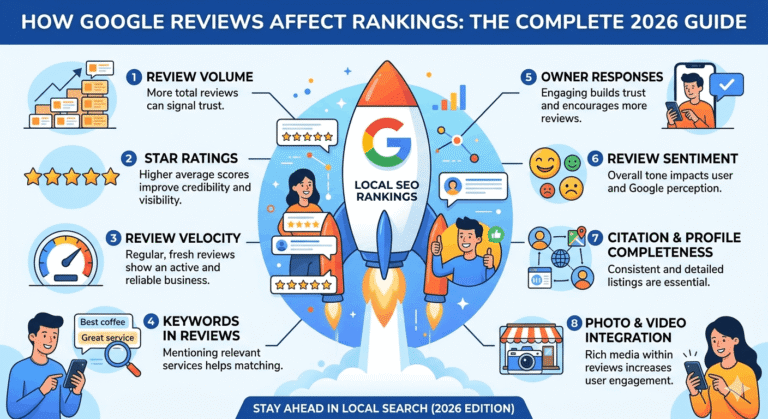
Reviews
Reviews are one of the strongest trust signals.
Google analyzes:
- Quantity
- Quality
- Keywords inside reviews
- Recency
- Response activity
- Review diversity
A business with 400 recent, authentic reviews usually outranks one with 30 outdated reviews.
Local Citations
Citations are mentions of your business across the web.
Examples:
- Yelp
- Justdial
- Sulekha
- Bing Places
- Apple Maps
- Industry directories
Consistency matters heavily.
Website Authority
Your website still impacts Google Maps optimization.
Google evaluates:
- Local relevance
- Content quality
- Technical SEO
- Backlinks
- Schema markup
- Page experience
- Location landing pages
Strong local SEO boosts GBP rankings significantly.
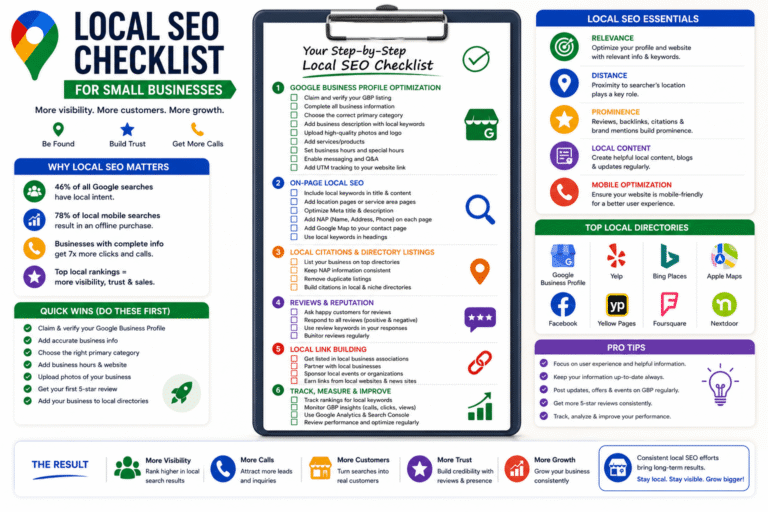
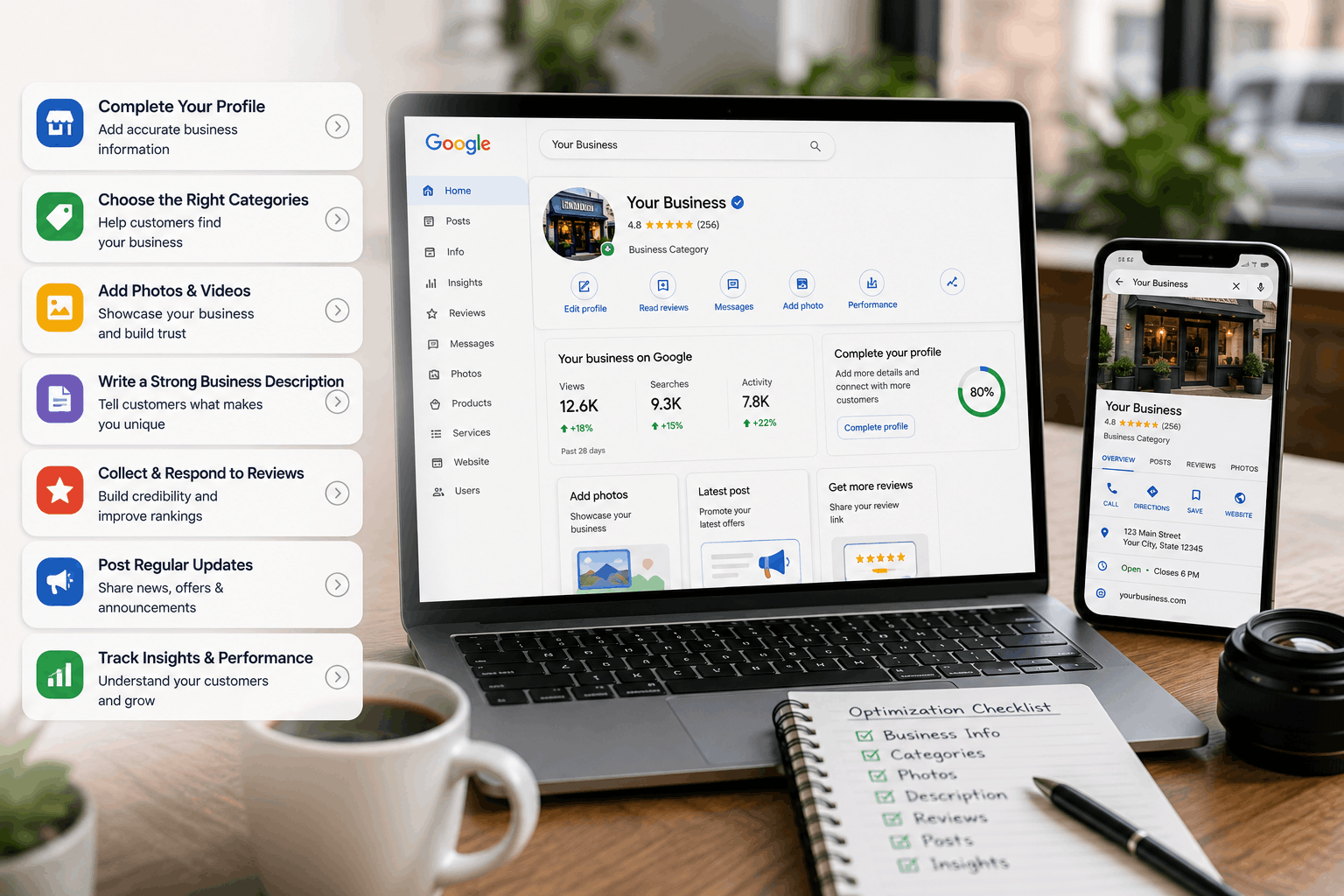
Complete Google Business Profile Optimization Checklist
Choose the Correct Business Category
This is one of the biggest ranking factors.
Your primary category tells Google what your business actually is.
Bad Example
Primary category: “Consultant”
Better Example
Primary category: “Digital Marketing Agency”
Specificity matters.
How to Choose Categories
- Study top competitors
- Use the exact service category
- Avoid broad generic categories
- Add secondary categories carefully
Do not add irrelevant categories just to chase traffic.
That can hurt relevance.
Optimize Your Business Name Properly
Your business name should reflect your real-world branding.
Common Mistake
“ABC Dental Clinic Best Dentist Bangalore Teeth Whitening”
That violates Google guidelines.
Keyword stuffing may temporarily help rankings, but it increases suspension risk.
Best Practice
Use your actual registered business name.
If keywords naturally exist in the brand name, that’s fine.
Write an SEO-Friendly Business Description
You get 750 characters.
Use them wisely.
Include:
- Primary services
- Location relevance
- Unique selling points
- Experience
- Trust indicators
Example
“XYZ Plumbing provides emergency plumbing, leak repair, drain cleaning, and water heater installation services across Melbourne. With over 15 years of experience, our licensed plumbers offer same-day residential and commercial plumbing solutions.”
Avoid:
- Keyword stuffing
- Excessive capitalization
- Promotional spam
Add Products and Services
Most businesses ignore this section.
That’s a huge mistake.
Adding services improves:
- Relevance
- Keyword coverage
- Conversion rates
Include:
- Detailed service descriptions
- Pricing if possible
- FAQs
- Benefits
Optimize Service Areas
For service-area businesses:
- Define realistic service zones
- Avoid selecting huge regions unnecessarily
- Focus on actual coverage areas
Smaller, highly relevant areas often perform better.
Upload High-Quality Images
Photos dramatically affect engagement.
Businesses with active photo uploads usually get:
- More clicks
- More calls
- Higher trust
Upload:
- Exterior photos
- Interior photos
- Team photos
- Before/after images
- Product photos
- Work process photos
Pro Tip
Add new photos weekly.
Freshness matters.
Add Videos
Short videos increase engagement substantially.
Good video ideas:
- Customer walkthroughs
- Team introductions
- Product demos
- Service process videos
Keep videos:
- Short
- Clear
- Well-lit
- Authentic
Optimize Business Hours
Incorrect hours frustrate users and reduce trust.
Always:
- Update seasonal hours
- Add holiday hours
- Reflect temporary closures accurately
Google prioritizes reliable listings.
Optimize Attributes
Attributes improve relevance and conversions.
Examples:
- Wheelchair accessible
- Women-owned
- Free WiFi
- Online appointments
- Outdoor seating
Many users filter results using attributes.
Enable Messaging
Messaging can improve lead generation significantly.
Respond quickly.
Slow response times reduce trust.
Add Booking and Appointment Links
If applicable, integrate:
- Calendly
- Booking software
- Reservation systems
Reducing friction improves conversions.
Optimize Questions & Answers
The Q&A section is massively underused.
You can seed common customer questions yourself.
Examples:
- “Do you offer same-day service?”
- “Is parking available?”
- “Do you accept walk-ins?”
This improves:
- Relevance
- Conversions
- User experience
Build a Review Generation Strategy
Reviews directly impact local pack ranking factors.
Best Practices
- Ask consistently
- Request reviews immediately after service
- Use SMS and email follow-ups
- Make review links simple
Pro Tip
Teach customers what to mention naturally.
Instead of:
“Please leave a review.”
Try:
“If possible, mention the service you received and your experience.”
That helps keyword relevance organically.
Optimize Review Responses
Respond to every review.
This signals activity and trust.
Good Response Example
“Thank you for choosing our HVAC repair service. We’re glad our emergency technician could solve the issue quickly.”
Notice the natural keyword inclusion.
Post Regularly on GBP
Google Posts improve freshness signals.
Post:
- Offers
- Events
- Updates
- Promotions
- Tips
- Announcements
Weekly posting is ideal.
Add Offers and Events
Promotional posts often increase conversions.
Examples:
- Holiday sales
- Seasonal offers
- Limited-time discounts
- Community events
Optimize Menus (Restaurants)
Restaurant profiles should maintain updated:
- Menus
- Pricing
- Specials
- Photos
Outdated menus hurt trust badly.
Add UTM Tracking
Use UTM parameters to track GBP traffic inside analytics tools.
Example:
utm_source=google&utm_medium=organic&utm_campaign=gbp
This helps measure:
- Calls
- Website visits
- Conversions
Optimize Your Website for Local SEO
GBP and website SEO work together.
Important local SEO elements:
- Location pages
- Service pages
- Fast loading speed
- Mobile optimization
- Local keywords
- Embedded maps
- Local schema
Maintain NAP Consistency
NAP = Name, Address, Phone Number.
Your business information must remain consistent everywhere online.
Even small inconsistencies create confusion.
Build Local Citations
Citations strengthen trust and local relevance.
Prioritize:
- Industry directories
- Local directories
- Chamber of commerce listings
- Niche sites
Quality matters more than quantity.
Build Local Backlinks
Backlinks remain powerful.
Great local backlink opportunities:
- Local blogs
- News sites
- Sponsorships
- Community events
- Partnerships
- Local organizations
Implement Schema Markup
Schema helps search engines understand your business better.
Important schema types:
- LocalBusiness
- FAQPage
- Review
- Service
- Organization
Geotagging Myths vs Reality
Many people believe geotagging photos dramatically improves rankings.
In reality:
- Geotagging has minimal direct impact
- Photo quality and engagement matter more
Do not waste excessive time obsessing over EXIF data.
Google Business Profile Content Strategy
What Should You Post?
Focus on content that customers actually care about.
Examples:
- New services
- Customer success stories
- Before/after transformations
- Educational tips
- Team highlights
- Community involvement
Posting Frequency
Consistency matters more than volume.
Recommended:
- 1–3 posts weekly
- Weekly photo uploads
- Monthly video uploads
Types of High-Engagement Posts
High-performing content often includes:
- Offers
- Seasonal updates
- Real customer stories
- Local events
- Visual transformations
Authenticity beats overly polished corporate content.
Photo Strategy
Your images should:
- Look natural
- Show real environments
- Include people when possible
- Highlight actual work
Avoid generic stock photos.
Encourage User-Generated Content
Customers uploading photos improves trust heavily.
Encourage customers to:
- Share experiences
- Upload photos
- Tag your business
Seasonal Optimization
Update your profile seasonally.
Examples:
- Holiday offers
- Summer promotions
- Festival events
- Seasonal services
Fresh content signals activity.
Common Google Business Profile Mistakes
Keyword Stuffing
Stuffing business names with keywords is risky.
Google suspensions are increasing aggressively.
Fake Reviews
Buying reviews may produce temporary gains but creates major long-term risks.
Google’s spam detection systems continue improving.
Wrong Categories
Many businesses unknowingly choose poor categories.
This damages relevance immediately.
Duplicate Listings
Duplicate profiles confuse Google and dilute authority.
Always merge duplicates properly.
Inconsistent NAP
Different addresses or phone numbers reduce trust signals.
Ignoring Reviews
Unanswered negative reviews damage conversions.
Suspension Risks
Common suspension triggers:
- Virtual offices
- Fake addresses
- Keyword stuffing
- Ineligible business models
- Frequent edits
- Fake engagement
Advanced GBP Optimization Strategies
Competitor Analysis
Study top-ranking competitors carefully.
Analyze:
- Categories
- Reviews
- Photos
- Posting frequency
- Keywords
- Landing pages
You’ll often discover ranking patterns quickly.
Heat Map Ranking Tracking
Rank tracking tools show visibility across geographic grids.
This helps identify:
- Weak zones
- Strong zones
- Local ranking gaps
Extremely useful for local SEO agencies.
Entity SEO
Google increasingly understands businesses as entities.
Strengthen entity signals through:
- Consistent branding
- Structured data
- Author mentions
- Press mentions
- Social profiles
- External references
Build Topical Authority
Your website should deeply cover your services.
Instead of one generic page:
- Create service-specific pages
- Add FAQs
- Publish local guides
- Create educational content
Authority compounds over time.
AI Search Optimization
AI Overviews and conversational search are changing local SEO.
To optimize:
- Use natural language
- Answer questions directly
- Add FAQs
- Build strong entity signals
- Maintain accurate GBP data
AI systems increasingly rely on trusted business profiles.
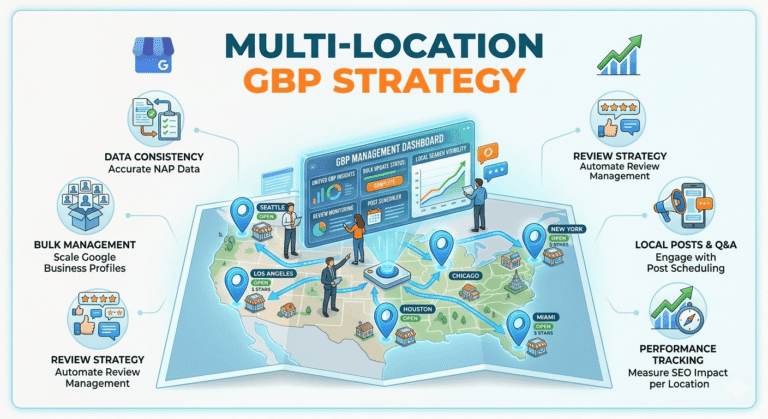
Multi-Location Optimization
For businesses with multiple branches:
- Create unique profiles
- Build unique landing pages
- Use location-specific photos
- Generate reviews for each location separately
Never duplicate content across locations.
Hyperlocal Landing Pages
Create pages targeting:
- Neighborhoods
- Districts
- Nearby suburbs
Example:
“Emergency Plumber in Richmond”
instead of only “Melbourne Plumber.”
Behavioral Optimization Strategies
Encourage actions that improve engagement:
- Calls
- Direction requests
- Clicks
- Bookings
Listings with stronger interaction patterns often improve rankings.
Google Business Profile Suspension & Recovery
Common Suspension Reasons
Frequent causes include:
- Address violations
- Fake locations
- Keyword stuffing
- Spam edits
- Unsupported business types
Soft Suspension vs Hard Suspension
| Suspension Type | What Happens |
| Soft Suspension | Listing visible but unmanaged |
| Hard Suspension | Listing removed entirely |
Hard suspensions are much more serious.
Recovery Process
Recovery usually involves:
- Fixing violations
- Submitting evidence
- Reverification
- Filing reinstatement request
Documentation helps enormously.
Prepare:
- Business licenses
- Utility bills
- Storefront photos
- Registration records
Verification Best Practices
Keep verification details consistent.
Avoid:
- Frequent edits immediately after verification
- Spammy changes
- Virtual office addresses
AI Search & Future of Local SEO
Google is moving rapidly toward AI-driven search experiences.
This changes how businesses appear online.
AI Overviews
AI-generated summaries increasingly appear above traditional search results.
GBP data strongly influences:
- Business recommendations
- Local suggestions
- Service comparisons
Conversational Search
Users now search conversationally:
- “Who’s the best dentist near me open now?”
- “Which bakery has vegan options nearby?”
Profiles optimized with detailed information perform better.
Voice Search Optimization
Voice searches are highly local.
Optimize for:
- Natural language
- FAQ content
- Conversational queries
- “Near me” intent
GBP Data Powers AI Answers
Google trusts structured business information heavily.
Profiles with:
- Accurate details
- Strong reviews
- Active engagement
- Updated content
are more likely to appear in AI-generated answers.
Google Business Profile Optimization Checklist Summary
Core Optimization Tasks
| Task | Priority |
| Correct primary category | Critical |
| Complete profile | Critical |
| Review generation | Critical |
| Weekly posts | High |
| Photo uploads | High |
| Website local SEO | High |
| Citation consistency | High |
| Local backlinks | Medium |
| Video uploads | Medium |
| Schema markup | Medium |
Frequently Asked Questions
How long does Google Business Profile optimization take?
Most businesses begin seeing improvements within 4–12 weeks depending on competition and market conditions.
What is the most important GBP ranking factor?
Primary business category, reviews, proximity, and overall prominence are among the strongest factors.
How often should I post on Google Business Profile?
At least once weekly is recommended for consistent engagement and freshness signals.
Do reviews improve Google Maps rankings?
Yes. Reviews strongly impact trust, engagement, and local relevance.
Can I rank outside my city?
Yes, but rankings weaken with distance unless your authority and relevance are extremely strong.
Are keywords in reviews important?
Yes. Natural keyword mentions can improve relevance.
Does adding photos help rankings?
Photos improve engagement, trust, and click-through rates, which indirectly supports rankings.
Can Google suspend my profile for keyword stuffing?
Yes. Keyword stuffing in business names is a major suspension trigger.
Should I buy Google reviews?
No. Fake reviews violate Google guidelines and create long-term risks.
Do citations still matter for local SEO?
Yes. Consistent citations remain important trust signals.
How many categories should I add?
Use one primary category and only highly relevant secondary categories.
Does website SEO affect GBP rankings?
Absolutely. Strong local SEO strengthens Google Maps visibility.